

How To Clean Flat Flexible Cable On Circuit Board
In the PCB associates, stiffeners are a typical necessity in numerous flex circuit designs. Flexible circuit boards are one of the popular printed circuit boards now on the market place. Flex PCBs volition fit into the places where we find it hard to integrate the rigid boards.
In this article we will be addressing the following points:
- What is a stiffener in a flex PCB?
- What are the uses of PCB stiffeners?
- Why practice flex PCBs need stiffeners?
- The flex PCB stiffener material
- How to use flex PCB stiffeners?
- Departure between rigid-flex and rigid PCBs based on FR4 stiffeners
- Stiffener considerations
- Sample of rigid-flex stack-up with stiffeners
What is a stiffener in flex PCB?
A stiffener isn't an electrical piece of the PCB, yet assumes the job of offering mechanical support. It is an additional mechanical piece that provides mechanical support to the PCB during the assembly.
Flex PCBs have their downsides too; they may be too flexible! They may not be rigid in places that need stiffness. This is where human experience came into action. Nosotros created PCB stiffeners for these situations.
What are the uses of stiffeners?
We apply a stiffener when we have to harden a specific area in the flex circuit. Showtime, we need to sympathize that the PCB stiffener is non an integral part of the electrical circuit board pattern. This will not let the excursion bend and will protect the integrity of the part'due south solder joint. Here are some enlisted reasons to phone call for stiffeners:
- Mechanically support the specific areas of the board that contain SMT and/or PTH components.
- Go on upwards the legitimate thickness in the flex excursion.
- Support PCB components and connectors.
- Constrain the flexible parts to rigid areas as per requirement.
- Facilitate better handling of a sparse flimsy circuit board.
- Keep certain areas of flexible circuits apartment and stable.
- Come across Zip Insertion Forcefulness (ZIF) connector specifications.
- Increase the curve radius of the circuit at the intersection of the rigid and flex role. This will avoid the stress on the flex part during multiple bending operations.
- Road and retain arrays. In order to achieve this, the stiffener material will be extended into the array.
Why do flex PCBs need stiffeners?
Stiffeners are required when:
- Components are placed in a flex zone.
- The weight of the components placed in a flex zone stresses the flex material.
- There is a requirement of creating a flat and rigid surface on the flex for the placement of SMT pads components.
- Connectors that require multiple insertions would need a stiffener to help reduce the stress of the pads.

The flex PCB stiffener material
Selecting the correct fabric for the PCB stiffeners is vital as it provides a broad range of benefits in our awarding. In this section, we will learn about the typically used stiffener materials in the flex circuits. Typically, PCB stiffeners are made upward of FR4 or Rigid Polyimide.
FR4 is a woven drinking glass-fiber laminate impregnated with epoxy resin. Polyimide is produced using high-temperature polymer formed into a thin film layer. Numerous layers tin can be stacked to accomplish greater thickness. Kapton is 1 of the classic polyimides used in PCB stiffeners. Kapton is frequently used when the flex ends need to be thickened and inserted into a ZIF connector.
In sure situations, you may need to use other materials such as stainless steel or aluminum, for your PCB stiffener. However, these materials are more expensive.
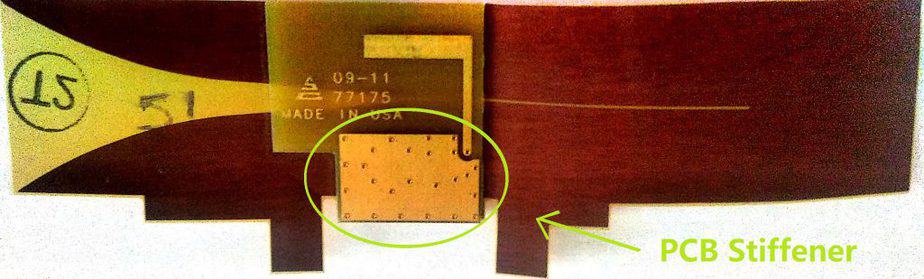
Typical stiffener thicknesses:
The thickness of the stiffener ranges from 0.002″ to 0.059″. The thickness of the Kapton stiffeners range from 0.002" to 0.010" and the thickness of the rigid stiffeners range from 0.008" to 0.059". The thicker the PCB stiffener is, the more support it will offering. But every design seeks a different thickness. If y'all desire your circuit board to be thicker, y'all volition accept to use polyimide stiffeners.
How to apply PCB stiffeners?
When we use a stiffener for plated-through hole (PTH) components, the stiffener(s) should be located on the same side of the flex from which the components are inserted. This allows access to solder pads on the flex circuit. You can also attach stiffeners to both sides of a office but and so the PCB assembly will require an array configuration review. When we crave an assembly array for flex excursion designs, it is common and toll-constructive to include the FR4 stiffener throughout the assortment edge. This concludes into a rigid array. This, in most cases, allows the parts to run through automated assembly in the same manner as a rigid circuit lath blueprint. It also eliminates the need for whatsoever additional tooling plates, etc.
Typically, we will use estrus and pressure level (thermal bonding) to attach the stiffener to the excursion. We can also attach PCB stiffeners with a pressure-sensitive adhesive.
The 2 pop types of adhesives generically fall under Pressure-Sensitive Adhesives (PSA) and thermally bonded adhesives. The selection of the adhesive depends on the various performance requirements like thermal exposure, chemic resistance, and adhesion to various materials.
Divergence between rigid-flex and rigidized PCBs
- Rigidized flex is a flex PCB, yet it's bonded with FR4 stiffener to strengthen the rigidity during assembly. Rigid-flex circuits are known as hybrid flex circuits involving rigid and flexible substrates. Nosotros laminate them into a single structure.
- There are no traces on a rigid part of rigidized flex, fifty-fifty on pads. This rigid part merely strengthens the rigidity of this location. That is to say, it only provides mechanical back up to the flex. However, for the rigid-flex PCB, both the rigid and the flex parts are designed with traces and nosotros connect them via holes. That is to say, it's not mechanical back up but an electrical connexion for the rigid-flex PCB.
Rigid-flex PCBs have electrical connections whereas rigidized PCBs are for mechanical support.
To know more than virtually rigid-flex PCBs read our article Rigid-Flex Cuts Electronic Production Assembly Costs.
PCB stiffener considerations
- Stiffeners should overlap bared coverlay by .030" to relieve stress. Coverlay acts as a solder resist for the flex PCB.
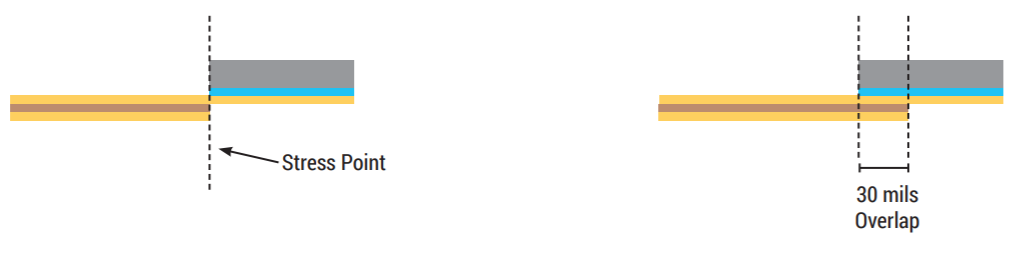
- Maintain the same stiffener thickness when using multiple stiffeners.
To know more about flex design considerations check out Fugitive Common Flexible PCB Errors and Designing for Success
Advantages of using PCB stiffeners
- Stiffeners strengthen solder joints due to which chafe resistance will be increased.
- Stiffeners can be used for strain relief and heat dissipation.
Flex PCBs come with numerous advantages. To know more about it read our commodity The Advantages of Flex PCBs And Their Applications
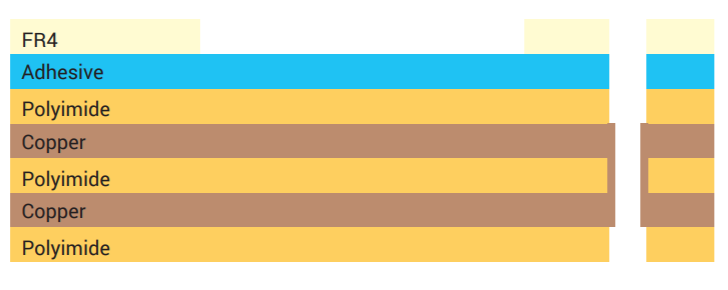
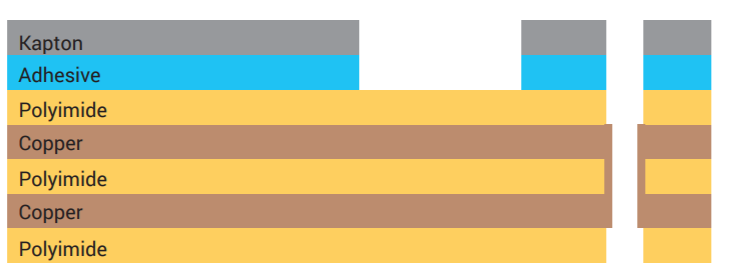
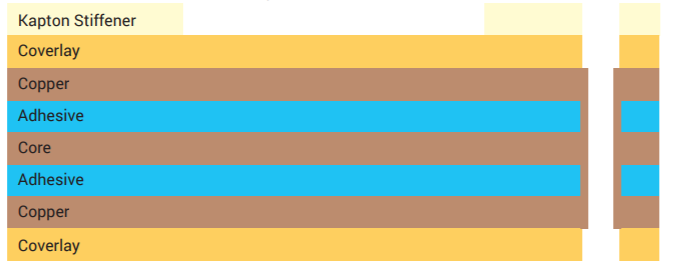
Sample rigid-flex stackup with stiffeners
Let usa have a look at a few sample rigid-flex stackup with PCB stiffeners.
Conclusion:
We employ a stiffener when we require a rigid area in our flex circuit, to protect components or connectors fastened there. This will protect the circuit from bending and the integrity of the solder joints is shielded. FR4 materials are commonly used for stiffeners, this textile can be attached with thermally cured acrylic adhesive or pressure-sensitive adhesive. This serves our requirement of rigidizing the specific area in our flex circuit.
Flex PCB Design Guide
10 Capacity - 39 Pages - 45 Infinitesimal Read
What's Inside:
- Calculating the bend radius
- Annular band and via specifications
- Build your flex stack-up
- Controlled impedance for flex
- The fab and drawing requirements
Download At present

Source: https://www.protoexpress.com/blog/guide-pcb-stiffeners-flex-rigid-flex/
Posted by: carsondereter.blogspot.com
0 Response to "How To Clean Flat Flexible Cable On Circuit Board"
Post a Comment