

How Long Did It Take To Clean Up The Pentagon
Clean Power From the Pentagon
The Department of Defence's research and innovation system is particularly well-suited to advancing make clean energy technologies in both the armed services and civilian sectors.
The Department of Defense (DOD) in 2022 volition invest $1.6 billion in enquiry, development, exam and evaluation (RDT&E) that is directly related to energy. The magnitude of the investment reflects the importance of energy to the armed services mission. Everything the military do requires free energy, which is why DOD is the single largest energy consumer in the United states of america.
DOD'southward investment in energy RDT&E also reflects the military's feature pursuit of advanced technology as a force multiplier. DOD played a major role in the development of three of the most important energy innovations of the by 75 years—the nuclear reactor, the gas turbine/jet engine, and the solar photovoltaic (PV) prison cell—and information technology has been the driver for many major not-energy innovations too, including radar, satellites, GPS, lasers, computers and semiconductors, robotics, artificial intelligence, and the cyberspace.
Although DOD's investments in energy RDT&Eastward are driven by military needs, they take significant potential to catalyze civilian make clean free energy innovation, according to our recent report for the Information technology & Innovation Foundation. DOD'due south needs are more coinciding with priorities for civilian clean free energy innovation than is commonly recognized. Moreover, DOD's approach to innovation is well-suited to energy engineering and even addresses gaps in the efforts of the authorities'southward prime agency for civilian energy matters, the Department of Free energy (DOE).
Despite their overlapping technology priorities and complementary approaches to innovation, DOE does relatively piddling to leverage DOD's investments in energy or its strengths as an innovator. This is a huge missed opportunity. As the United States strives to accost such diverse energy innovation challenges as combating climate change and assuring long-term energy security, Congress and the Trump administration should make the well-nigh of existing federal energy investments by encouraging greater DOD-DOE collaboration.
Defense investments in energy innovation
DOD consumes energy for 2 broad purposes. The commencement is to support operations. Operational free energy refers to the fuel used to power armed forces platforms (e.1000., aircraft, large drones, ships, tanks) and to run the diesel generators that produce electricity at contingency bases in places such as Republic of iraq and Afghanistan. Increasingly, it likewise includes nonfuel forms of energy such as the batteries that power troops' portable electronic devices.
The 2nd use of energy is to support DOD's roughly 500 indelible armed forces bases, or "fixed installations," in the United States and overseas. Installation energy consists largely of the electricity and natural gas used to power the 300,000 buildings located on these installations, with their two billion square feet of building space.
Considering energy is essential to its gainsay mission, the military uses a lot of it. In financial year 2022, DOD consumed 708,000 billion British thermal units (Btus) of operational and installation energy, which is more than 75% of the federal government's total free energy consumption and about 1% of full United states energy consumption.
With the goal of "enhancing mission effectiveness and reducing operational risk," the armed forces'southward free energy RDT&E investments are targeting five "warfighter opportunity areas."
Soldier Ability: This refers to the energy needs of private foot soldiers and modest troop units. These troops are positioned in remote areas, where conditions are harsh, and they suffer nearly of the gainsay casualties. Soldiers lug as much as 100 pounds of armor, ammunition, and h2o—and an increasing number of electronic devices. A soldier must carry plenty batteries to power these devices for a standard 72-60 minutes patrol, and the Army wants to extend the patrol to 144 hours. In addition to developing better batteries and wireless recharging technology, DOD is investing in the development of a wide range of other portable energy sources, including fuel cells, wearable solar PV, and devices to harvest kinetic energy created by the soldiers' ain motions.
Base Power: The free energy challenge for contingency bases located abroad from fixed installations is to reduce their reliance on transported fuel—resupply convoys were the most vulnerable target for insurgent attacks in Iraq and Afghanistan—even as they meet the growing demand for electricity to power computers and communications equipment, 3-D manufacturing, and protective weaponry. In addition to addressing the outposts' notoriously wasteful free energy practices, the military machine is investing in culling forms of energy, including wind and solar, fuel cells, waste material-to-energy systems, and energy storage. DOD is also developing tactical (mobile) microgrids that will integrate renewable free energy sources and allow diesel generators to operate more efficiently.
Fixed installations rely on a commercial grid only must maintain ability to mission-critical loads during grid outages, which are becoming more frequent and severe in the United States due largely to weather events. As fixed installations provide more directly support for combat activity (e.g., flight command for foreign drone operations), they as well confront growing risks from physical- and cyber-attacks carried out via the grid. To brand installations more energy secure, DOD is deploying renewable energy (largely solar PV) and demonstrating precommercial microgrid and storage technologies.
Platform Power: Manned platforms—aircraft, ships, and ground vehicles—business relationship for near of the military's fuel consumption, and the largest energy RDT&Eastward efforts are aimed at enhancing aviation propulsion. For nonnuclear ships and ground vehicles, DOD is shifting to hybrid-electric propulsion (i.e., electrification), primarily to facilitate the dramatic increase in onboard electrical equipment. A key challenge is the vehicles' power distribution network, which—like a tactical microgrid—must ensure that individual loads (e.g., propulsion, computers, sensors, weapons) receive the electrical ability they need when they demand it. These networks in turn require improved technology for power electronics—the ubiquitous process of controlling the voltage or frequency of electrical energy and converting it from one course to another (e.thousand., AC to DC) to adjust the load.
Democratic System Power: Autonomous platforms, including unmanned aeriform vehicles, ground vehicles, and underwater vehicles, are transforming the battlefield. As with manned platforms, DOD is embracing electrification for many of its unmanned systems. However, limits on energy engineering science hamper DOD from deploying big numbers of these systems and taking advantage of their total potential—specially the capacity for long-duration operation in unique and challenging environments. RDT&East goals include better batteries, long-running fuel cells, solar-powered drones, and long-altitude recharging of drones.
Weapon Power: This refers to the energy needs of directed energy weapons (DEWs) such equally loftier energy lasers that emit beams of low-cal or microwaves powerful plenty to dethrone or destroy a target. In one case seen as futuristic "death rays," DEWs are at present viewed as tactical systems that could zap a swarm of drones or incinerate an enemy rocket at a fraction of the cost of a missile. DEWs are a high priority for DOD, but free energy is the rub: they need free energy systems with exceedingly high power levels, rapid recharge capability, and the power to manage the waste oestrus generated by all that power.
Catalyzing civilian make clean free energy innovation
DOD's mission-driven RDT&E already has contributed significantly to clean free energy innovation and can exist even more of a catalyst in the future. War machine energy needs oftentimes parallel civilian clean energy priorities despite the difference in underlying goals. For example, climate hawks desire to "electrify everything" to pause the economy's dependence on fossil fuels. DOD is embracing electrification too—but not to reduce its carbon footprint, rather because electronic equipment increasingly dominates warfare.
In improver to the congruence of military machine and civilian free energy technology priorities, DOD's mission-driven approach to innovation is well-suited to energy technology. Historically, commercial innovation has benefited direct from a variety of DOD practices, including investment in foundational science, technology, and applied science; pursuit of technologies for armed services apply that find a commercial market once their costs come down ("spin-off"); investment in R&D to leverage and advance commercial technology ("spin in"); heavy reliance on engineering science sit-in and validation; and procurement of new technologies that offer potentially decisive advantages over existing ones, oft at a price premium, at sufficient scale to bound-get-go the commercial market. The last two mechanisms (technology demonstrations and procurement at a price premium) are particularly valuable for energy innovators because of the complexity of energy technology and the importance of cost competition in the energy market place.
To appreciate DOD'due south catalytic role, consider iv technologies that are central to a clean free energy future: solar PV, portable batteries, microgrids and stationary energy storage, and wide bandgap (WBG) semiconductors for ability electronics.
Solar PV: This is a must-have for DOD, to enable longer missions for foot soldiers, extend unmanned aerial vehicles' flying duration, and reduce contingency bases' dependence on transported fuel. Even so, these and other war machine applications telephone call for solar PV materials that are lightweight and flexible, whereas the ascendant solar PV technology, silicon, is heavy and inflexible. Some niche and emerging technologies, including multijunction Iii-V and perovskite materials, show hope; merely silicon's cost advantage represents a major bulwark to entry—a bulwark reinforced by DOE'south policy focus on minimizing the levelized toll of solar electricity. (Levelized price measures the average price per unit of free energy of a ability source over its lifetime, which allows for comparison of generation methods with very different beginning-up and operation costs.)
DOD could be instrumental in prying open the market for solar PV and extending it to important new applications. DOD has long funded advances in Three-V materials for apply in space. Although 3-5 cells are significantly more expensive, their greater efficiency (roughly double that of silicon) more than offsets the college cost when the surface area to be covered (e.g., a satellite) is pocket-size. With an heart to other applications, including space-based solar (capturing solar energy in space and transmitting information technology to Earth in the course of microwaves or lasers), DOD is supporting RDT&East to slash the cost to fabricate 3-V materials. DOD is too supporting research on perovskites, organics, quantum dots, and other emerging solar PV technologies.
In addition to supporting R&D, DOD tin can be a valuable early on adopter of promising solar PV technologies. This is nothing new: although Bell Laboratories invented the silicon PV cell in 1954, government satellites represented the major market for solar PV until the 1970s. The military's willingness to pay a premium for higher performance can give the new solar PV technologies an opportunity to grow and gain a commercial foothold, get-go with less toll-sensitive applications such as device charging and building- and vehicle-integrated solar PV.
Portable batteries: As with solar PV, DOD wants to leverage the commercial market for portable batteries but cannot see its requirements with the existing technology, largely lithium-ion batteries. For mobile missions (soldiers, manned platforms, and democratic systems), where the goal is to extend duration and reduce weight, DOD needs batteries with a college energy density and more rapid recharge rate. Condom is also disquisitional, and lithium-ion batteries can explode if penetrated by a bullet or catch burn if charged improperly (indeed, the Navy volition non allow them on submarines).
DOD'southward "stretch goals" for battery performance are ones that commercial customers endorse just are not notwithstanding willing to pay for. To bridge that gap, DOD funds technical activeness, frequently in partnership with industry, aimed at developing higher-performing batteries and improved manufacturing processes. From 2009 to 2022, DOD spent about $430 million on battery RDT&E—fully half the amount spent by DOE.
The military's desire to purchase commercial batteries, together with its needs-based approach to innovation, is a powerful combination. DOD'due south large RDT&E investment—exploiting industry partnerships and extending to manufacturing—can aid develop a new generation of batteries. And if the outset products are priced for college-end commercial markets, DOD can become an early on customer, helping to finance their rapid movement down the learning and cost curves.
Microgrids and stationary storage: Advanced microgrids and large-scale stationary storage, together with on-site energy generation, can create a newfound chapters for fixed installations to manage local energy supply and demand on a routine ground and maintain mission-critical loads if the grid goes down. DOD has sought to further the development of microgrid and storage technology by using its bases as test beds for the sit-in and validation of pre-commercial systems. Since 2009, DOD's Ecology Security Technology Certification Program (ESTCP) has funded 32 formal demonstrations of avant-garde microgrid technologies, many of which comprise innovative storage solutions.
ESTCP's demonstrations are primal to overcoming impediments to applied science commercialization and deployment. A microgrid's performance is affected by site-specific factors such every bit the variability of loads and the penetration of solar PV or other intermittent renewable free energy. Demonstrations allow vendors to validate their technology designs and potential buyers to analyze organization performance. General Electric's microgrid controller went directly from a iii-year demonstration at a Marine Corps base in California to the commercial market.
Similarly, the ESTCP demonstrations give vendors and base of operations personnel hands-on experience with large-scale storage solutions—costly new technology that must operate in volatile electricity markets. Lack of independent information on technical and economic performance is a major impediment to the adoption of large-scale storage engineering. The operation data collected in these demonstrations—data ESTCP makes public as a matter of policy—allows would-be commercial buyers to assess the risks and value to them.
Beyond demonstrations, DOD will play a key part as a technology customer. Every bit an early on adopter of promising microgrid and storage systems, the military volition bear many of the nonrecurring engineering blueprint costs, enabling vendors to offering commercial customers a lower price. And with 500 active-duty installations and hundreds of smaller National Baby-sit bases, DOD is on track to be, in addition to i of the start, one of the largest customers for advanced microgrids and big-scale storage technology.
Microgrids are no less valuable to DOD's contingency bases: by exploiting onsite energy sources such as solar PV and allowing diesel generators to operate at peak efficiency, tactical microgrids can reduce the need for transported fuel. As with catalyzing stationary microgrids, DOD tin play a pivotal role in the commercialization and widespread deployment of tactical microgrids.
The potential market for microgrids in developing countries and remote parts of the developed world is vast, and the type of organization needed (portable, easy to operate, and able to run in isolation from a filigree) is identical to the tactical microgrid DOD is developing. Although the technology is non yet sufficiently refined or affordable to penetrate this market, DOD, as an early adopter and large customer, tin can facilitate that process, including through the development and dissemination of technical standards that volition serve to increase competition and drive down costs.
Wide bandgap semiconductors. If their costs go down, WBG semiconductors have the potential to revolutionize power electronics. WBG materials such as silicon carbide and gallium nitride are more than efficient than the silicon devices currently used, which allows for superior current control and reduces energy losses. DOD'south involvement in WBG devices hinges particularly on their potential to increase power density and conversion speeds while enabling power electronics components to exist smaller and lighter. Hither once more, DOD can help advance their development and employ by serving as an early adopter and customer.
Considering of this applied science'southward potential to reduce worldwide free energy consumption, the Department of Free energy is devoting significant resources to the field, including support for PowerAmerica, a manufacturing innovation found based at North Carolina State University. DOE'southward initiatives, in turn, build on DOD RDT&E activities that go back nearly 50 years. In the 1970s, the Role of Naval Inquiry (ONR) funded the initial university research on WBG physics, materials science, and technology. In the 1980s, as WBG'due south potential to revolutionize radio frequency (RF) applications such as armed services radars became apparent, DOD expanded its research back up. In the 2000s, the Defense Advanced Research Projects Bureau (DARPA) undertook a major program to accelerate improvements in WBG materials for ability electronics as well equally RF applications, and ONR/DARPA support led to the development of the WBG solid-country electronics systems used today. In 2022, DOD used its authority under the Defence force Production Human action to ensure that the United States had the capacity to manufacture WBG devices for RF applications. A major beneficiary of this support was Cree Inc., now a leader in commercial power electronics.
Having spun off WBG engineering science to DOE and commercial industry, the military is now poised to spin information technology back in: DOD'due south side by side-generation platforms, including the Navy'southward electric transport and the Ground forces's hybrid-electrical combat vehicle, all require a level of performance in power electronics only WBG semiconductors can provide. Although WBG devices will exist costlier than silicon devices for some time, DOD tin play a critical role in the commercialization of WBG semiconductors, equally information technology did with the starting time integrated circuits in the 1960s, through its willingness to pay a premium for functioning. The scale of the armed services market place for WBG devices will then allow device manufacturers to ramp up product and capture economies of both calibration and the process of "learning past doing."
Beyond these iv key technologies, DOD RDT&E and procurement hold promise for advancing other make clean energy technologies as well. These include:
Wireless ability transmission: DOD wants to recharge drones remotely and then they can remain aloft longer, and demonstrations using lasers are under fashion. The applied science requires direct line of sight but can piece of work at distances up to half dozen.8 miles. Long-distance wireless recharging will facilitate the electrification of footing vehicles, among other clean free energy applications.
Fuel cells: Fuel cells' ability to provide long-lasting ability is valuable to DOD. The Navy and General Motors developed an undersea drone powered by a hydrogen fuel jail cell that tin can operate without recharging for more than threescore days; and the Navy's fuel-prison cell-powered aeriform drone can fly for 48 hours.
Edifice technologies: DOD has funded more 130 on-site demonstrations of innovative energy technologies for the congenital environment, including such things as electrochromic glass and remote auditing tools. As the owner of 300,000 buildings, DOD has a directly interest in seeing these technologies commercialized and deployed.
Very small modular nuclear reactors: Stock-still installations in remote areas are an ideal market place for these greatly down-sized reactors, and DOD could aid their commercialization as an early on customer. (By contrast, the use of such reactors on contingency bases, which DOD is exploring, would not facilitate their commercialization because DOD's requirements are unique.)
Not all clean free energy technologies are candidates for DOD RDT&E support, nonetheless. As ane example, contrary to the view of many people, avant-garde biofuels would exercise picayune to assist the warfighter. Fuel is a commodity that DOD purchases in global markets and accesses through commercial supply bondage, and the evolution of biofuels would not touch price or availability except over the long term. Although getting fuel to the front end remains a serious claiming, the risks are the aforementioned whether the convoy is transporting biofuels or petroleum. To be sure, DOD volition buy bioalternatives to petroleum as they go toll-competitive (it is already doing that on a limited footing). Even so, it is unlikely to invest significant RDT&E resource to develop them.
Interagency collaboration critical
Despite the magnitude of the armed services's investment in free energy RDT&E and its relevance for clean energy innovation, DOD and DOE have limited interaction with respect to free energy engineering science. This is particularly unfortunate considering the 2 departments take such complementary approaches to innovation, and closer collaboration would make DOE a stronger innovator. (It would also aid DOD, but DOE stands to benefit more than.)
Effigy i compares DOE and DOD in terms of the fraction of their free energy RDT&E budgets that goes into different categories of innovation activity. DOE's energy RDT&East budget (referred to in DOE equally research, development, and demonstration, or RD&D) is devoted heavily to cardinal research, while DOD's skews heavily to engineering development and translation. Although DOE's Advanced Inquiry Projects Agency-Energy (ARPA-E) and some of the programs in the department'south Energy Efficiency and Renewable Free energy system support R&D that is more applied, their individual budgets are dominated by the energy budget of DOE'due south Office of Scientific discipline, which funds exclusively fundamental research.
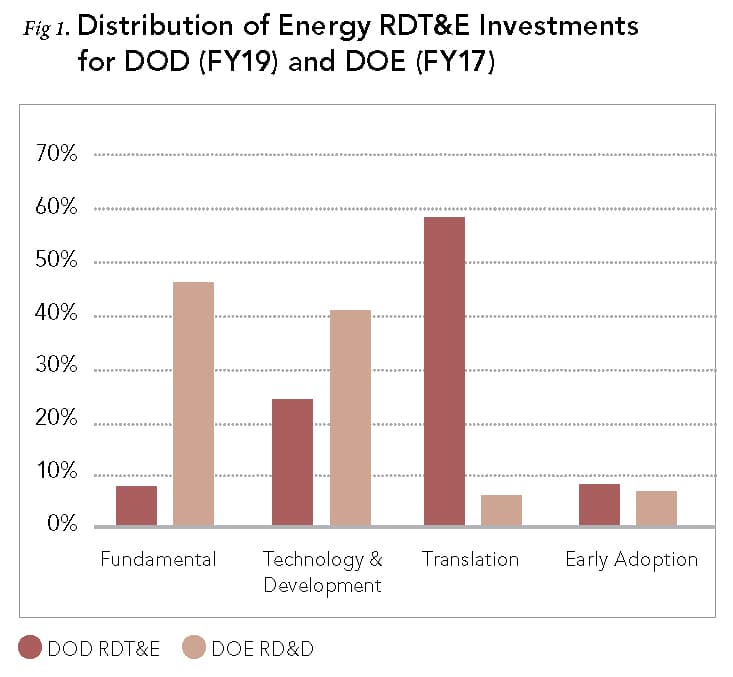
A related difference between the two departments has to practice with who performs the R&D. Fully 70% of DOE RD&D is performed in-house, by the national laboratories, while merely 36% of DOD RDT&E is performed by government laboratories (both figures refer to total R&D, not just energy R&D). Stated differently, DOD directs more than than twice as much of its RDT&E upkeep to universities and industry as does DOE. This general pattern holds true for basic and applied R&D, as well every bit DOD's downstream organization development activity, which is necessarily industry-dominated.
These statistics reflect qualitative differences in the 2 innovation systems. About significant, DOD's arroyo to innovation, including energy innovation, is driven by "need-pull" in the grade of requirements from the war machine customer. DOE'south arroyo, dominated by the Office of Scientific discipline, can be characterized as "science button."
In spite of their shared interests—and their history of collaboration on the blueprint and testing of nuclear and conventional weapons—DOE and DOD have limited interaction when it comes to energy innovation. The 2 departments engage in lilliputian joint R&D planning, fifty-fifty on fundamental free energy research and technology development. And DOE develops its applied free energy RD&D strategies and road maps with an eye to civilian energy needs and thus places a major focus on toll in the context of the commercial market.
To be off-white, DOD made energy a high priority for RDT&East only a trivial over a decade agone, and in 2022 DOE and DOD signed a memorandum of agreement to enhance cooperation on free energy security and clean energy innovation. The flurry of activeness that followed produced several successful efforts, including a collaboration betwixt DOD and DOE's ARPA-East on a long-duration free energy storage system suitable for filigree likewise as military applications.
Only the lack of sustained collaboration remains, and tin exist explained by several factors. Although the departments' memorandum of agreement had high-level support, it did non serve to motivate DOE and DOD program managers—individuals who were internally focused at the fourth dimension given the agencies' simultaneous ramp up of their energy RDT&E. Moreover, DOE'south Office of Science, both and then and now, avoids consideration of research applications. In add-on to the role'southward internal culture (Nobel prizes won are seen as a measure of impact), this avoidance reflects the influence of those contractor-operated DOE laboratories that want to protect their research programs, equally well as the views of DOE's congressional authorizers and appropriators.
With its focus on potential high-touch technologies, ARPA-E is DOD'southward most willing partner, and several joint projects are currently under manner, including one on the utilize of WBG semiconductors in shipboard power conversion. Outside of ARPA-E, however, DOE agencies and laboratories seem largely to pay lip service to collaboration with the military. In practice, the DOE labs tend to see DOD as a potential checkbook rather than a valuable test bed or a useful source of demand-pull. And the armed services are themselves standoffish, wary that "collaboration" is a euphemism for DOD ground the beak.
Precisely considering DOD and DOE approach innovation differently, greater collaboration holds the promise of pregnant synergy. DOE, in detail, stands to benefit: by its nature, it lacks the internal market that makes DOD such a powerful engine of innovation, and information technology is routinely criticized for the lack of uptake of its research results by commercial firms. A partnership with DOD in areas where the military'south needs are aligned with those of commercial users would innovate much-needed demand-pull into DOE'southward R&D process.
Several elements of DOD's approach to innovation are particularly valuable in an energy context. Starting time, free energy engineering does not move directly from minor-scale development to the market; vendors need to demonstrate their technologies at scale, under realistic conditions. Whereas opportunities for such learning past doing are rare in the free energy sector, DOD, with its energy needs and reliance on technology demonstrations, represents a unique resource. Second, because energy is a commodity, new entrants often take to compete solely on toll—a major hurdle given that the earliest versions of innovations are typically characterized by high capital and operating costs and limited reliability. With its large internal marketplace, DOD plays a much-needed role every bit an early adopter that values mission-relevant functioning over price.
DOD's arroyo to innovation can complement DOE'southward in some other way. Congress frowns on DOE "picking winners and losers" amidst competing technologies—a constraint that reflects, among other things, the power of large, well-established industry incumbents looking to maintain dominance. DOD, by contrast, routinely picks winners and losers based on mission considerations. By working more closely with DOD, DOE can gain the cover information technology needs to brand politically unpopular choices.
To capture potential DOE-DOD synergies, the departments demand to interact in 2 areas. The first is R&D planning. DOE should factor DOD'due south energy needs and its strengths equally an innovator into the strategies and road maps it develops for both its fundamental and practical RD&D. Where DOD has unique free energy needs, this process is non advisable. But in the many areas in which DOD's needs are aligned with those of commercial users, DOE's planning procedure should take into account DOD's big internal marketplace and its role as an early adopter.
The second area for collaboration is the execution of DOE's applied programs, including batteries, stationary storage, microgrids, solar, manufacturing, and modest modular reactors. These programs tin all benefit from an active partnership with DOD—one that includes date with DOD end users to empathize their needs, to identify specific opportunities to collaborate, and to implement demonstration projects that the private sector is unlikely to sponsor simply are necessary to build feel and confidence in new technologies.
To have DOE's battery engineering science programs equally an example, collaboration on key R&D could combine DOD'due south stretch goals (loftier energy density, rapid recharge, and improved prophylactic) with DOE's highly specialized research capabilities such every bit exascale calculating and genome modeling of battery materials. Collaboration on late-stage R&D should target DOD end users as an early adoption market.
DOE's solar programme is some other strong candidate for collaboration with DOD. Though this program is supporting early on-stage enquiry on perovskites and other new PV materials, its driving policy goal of reducing the levelized cost of solar electricity strongly favors depression-price silicon. DOD's demanding requirements tin provide a pathway to new PV materials that tin can compete with silicon. Contempo engagement between DOE and DOD on lightweight, flexible solar PV is a promising start.
A changing energy landscape
The military relies on energy for everything it does, and it consumes much of that energy in combat settings, where it is extremely costly—in homo lives as well as dollars—to obtain. Realistically, future military platforms and capabilities will require more than, not less, energy. DOD free energy needs are changing too as growing, and these changing mission needs—to electrify the battleground and deploy distributed and portable ability generation, smart energy networks, improved energy storage, and wireless ability transmission—are yielding new technologies that, information technology turns out, can also make important contributions to large-calibration decarbonization of the noncombatant energy sector.
The lack of collaboration between DOE and DOD is a weak link in this serendipitous procedure, and a significant wasted opportunity. If the complementarities between these agencies could exist exploited effectively, it would take enormous benefits for the nation and the earth. The Usa needs to use every weapon in the energy arsenal to fight climatic change. Congress needs to ensure that DOE and DOD work more closely together to advance common goals in energy engineering and exploit the opportunities for mutual gain hiding in plain sight.

Source: https://issues.org/clean-power-from-the-pentagon/
Posted by: carsondereter.blogspot.com
0 Response to "How Long Did It Take To Clean Up The Pentagon"
Post a Comment