

How To Implement Ipv6 In A Windows Environment
This browser is no longer supported.
Upgrade to Microsoft Edge to take advantage of the latest features, security updates, and technical support.
Guidance for configuring IPv6 in Windows for advanced users
Windows Vista, Windows Server 2008, and afterward versions of Windows implement RFC 3484 and use a prefix table to determine which address to use when multiple addresses are available for a Domain Name System (DNS) proper noun.
By default, Windows favors IPv6 global unicast addresses over IPv4 addresses.
Applies to: Windows x - all editions, Windows Server 2019, Windows Server 2016, Windows Server 2012 R2
Original KB number: 929852
Summary
It is common for Information technology administrators to disable IPv6 to troubleshoot networking-related bug such as name resolution bug.
Important
Internet Protocol version 6 (IPv6) is a mandatory part of Windows Vista and Windows Server 2008 and newer versions. Nosotros do not recommend that yous disable IPv6 or its components. If you do, some Windows components may non office.
We recommend using Prefer IPv4 over IPv6 in prefix policies instead of disabling IPV6.
Utilise registry central to configure IPv6
Important
Follow the steps in this section carefully. Serious problems might occur if you change the registry incorrectly. Before you alter it, back up the registry for restoration in instance problems occur.
The IPv6 functionality can be configured past modifying the following registry primal:
Location: HKEY_LOCAL_MACHINE\SYSTEM\CurrentControlSet\Services\Tcpip6\Parameters\
Name: DisabledComponents
Type: REG_DWORD
Min Value: 0x00 (default value)
Max Value: 0xFF (IPv6 disabled)
| IPv6 Functionality | Registry value and comments |
|---|---|
| Adopt IPv4 over IPv6 | Decimal 32 Hexadecimal 0x20 Binary xx1x xxxx Recommended instead of disabling IPv6. |
| Disable IPv6 | Decimal 255 Hexadecimal 0xFF Binary 1111 1111 Encounter startup delay occurs after you disable IPv6 in Windows if you encounter startup delay after disabling IPv6 in Windows 7 SP1 or Windows Server 2008 R2 SP1. Additionally, system startup will be delayed for five seconds if IPv6 is disabled by incorrectly, setting the DisabledComponents registry setting to a value of 0xffffffff. The correct value should be 0xff. For more information, see Internet Protocol Version 6 (IPv6) Overview. The DisabledComponents registry value doesn't affect the state of the check box. Fifty-fifty if the DisabledComponents registry primal is set to disable IPv6, the check box in the Networking tab for each interface tin can be checked. This is an expected behavior. Y'all cannot completely disable IPv6 as IPv6 is used internally on the system for many TCPIP tasks. For example, you will still be able to run ping |
| Disable IPv6 on all nontunnel interfaces | Decimal 16 Hexadecimal 0x10 Binary xxx1 xxxx |
| Disable IPv6 on all tunnel interfaces | Decimal ane Hexadecimal 0x01 Binary xxxx xxx1 |
| Disable IPv6 on all nontunnel interfaces (except the loopback) and on IPv6 tunnel interface | Decimal 17 Hexadecimal 0x11 Binary xxx1 xxx1 |
| Prefer IPv6 over IPv4 | Binary xx0x xxxx |
| Re-enable IPv6 on all nontunnel interfaces | Binary xxx0 xxxx |
| Re-enable IPv6 on all tunnel interfaces | Binary 30 xxx0 |
| Re-enable IPv6 on nontunnel interfaces and on IPv6 tunnel interfaces | Binary xxx0 xxx0 |
Note
- Administrators must create an .admx file to betrayal the registry settings of below table in a Group Policy setting.
- Yous must restart your estimator for these changes to take issue.
- Values other than 0 or 32 causes the Routing and Remote Access service to fail after this change takes effect.
By default, the 6to4 tunneling protocol is enabled in Windows when an interface is assigned a public IPv4 address (Public IPv4 address ways any IPv4 address that isn't in the ranges 10.0.0.0/8, 172.16.0.0/12, or 192.168.0.0/16). 6to4 automatically assigns an IPv6 accost to the 6to4 tunneling interface for each accost, and 6to4 dynamically registers these IPv6 addresses on the assigned DNS server. If this behavior isn't desired, nosotros recommend disabling the IPv6 tunnel interfaces on the afflicted hosts.
You tin can as well follow these steps to change the registry key:
-
Open an administrative Command Prompt window.
-
Run the following command:
reg add "HKEY_LOCAL_MACHINE\Organization\CurrentControlSet\Services\Tcpip6\Parameters" /v DisabledComponents /t REG_DWORD /d <value> /fNote
Replace the <value> with the corresponding value.
How to calculate the registry value
Windows use bitmasks to bank check the DisabledComponents values and determine whether a component should exist disabled.
To learn which component each chip (from depression to high) controls, refer to the following table.
| Proper name | Setting |
|---|---|
| Tunnel | Disable tunnel interfaces |
| Tunnel6to4 | Disable 6to4 interfaces |
| TunnelIsatap | Disable Isatap interfaces |
| Tunnel Teredo | Disable Teredo interfaces |
| Native | Disable native interfaces (also PPP) |
| PreferIpv4 | Prefer IPv4 in default prefix policy |
| TunnelCp | Disable CP interfaces |
| TunnelIpTls | Disable IP-TLS interfaces |
For each bit, 0 means fake and one means true. Refer to the following table for an case.
| Setting | Prefer IPv4 over IPv6 in prefix policies | Disable IPv6 on all nontunnel interfaces | Disable IPv6 on all tunnel interfaces | Disable IPv6 on nontunnel interfaces (except the loopback) and on IPv6 tunnel interface |
|---|---|---|---|---|
| Disable tunnel interfaces | 0 | 0 | 1 | i |
| Disable 6to4 interfaces | 0 | 0 | 0 | 0 |
| Disable Isatap interfaces | 0 | 0 | 0 | 0 |
| Disable Teredo interfaces | 0 | 0 | 0 | 0 |
| Disable native interfaces (besides PPP) | 0 | 1 | 0 | 1 |
| Adopt IPv4 in default prefix policy. | 1 | 0 | 0 | 0 |
| Disable CP interfaces | 0 | 0 | 0 | 0 |
| Disable IP-TLS interfaces | 0 | 0 | 0 | 0 |
| Binary | 0010 0000 | 0001 0000 | 0000 0001 | 0001 0001 |
| Hexadecimal | 0x20 | 0x10 | 0x01 | 0x11 |
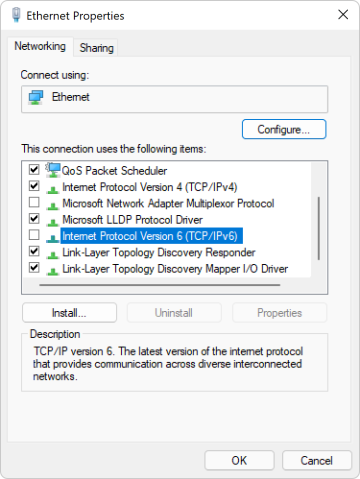
Using the network backdrop GUI to disable IPv6 is not supported
This registry value doesn't affect the land of the following check box. Even if the registry key is fix to disable IPv6, the check box in the Networking tab for each interface can be selected. This is an expected behavior.
Reference
For more information almost RFC 3484, see Default Accost Option for Internet Protocol version 6 (IPv6).
For more than data about how to set up IPv4 precedence over IPv6, see Using SIO_ADDRESS_LIST_SORT.
For information about RFC 4291, see IP Version six Addressing Compages.
For more than information about the related issues, encounter the articles below:
- Example 1: On Domain Controllers, y'all might run into where LDAP over UDP 389 will stop working. See How to use Portqry to troubleshoot Active Directory connectivity bug
- Instance 2: Exchange Server 2010, you might run into bug where Substitution volition stop working. Run across Arguments confronting disabling IPv6 and Disabling IPv6 And Exchange – Going All The Style.
- Example 3: Failover Clusters Run across What is a Microsoft Failover Cluster Virtual Adapter anyway? and Failover Clustering and IPv6 in Windows Server 2012 R2.
Tools to help with network trace: Microsoft Network Monitor three.4 (archive)
Warning
Netmon 3.4 isn't compatible with Windows Server 2012 or newer Os when LBFO NIC teaming is enabled. Use Message Analyzer instead.
Source: https://docs.microsoft.com/en-us/troubleshoot/windows-server/networking/configure-ipv6-in-windows
Posted by: carsondereter.blogspot.com
0 Response to "How To Implement Ipv6 In A Windows Environment"
Post a Comment